Media organizations in the country have been urged to deepen their partnership with stakeholders and put issues of Female Genital Mutilation, FGM, on the front burner at all times with a view to ending FGM in the country before 2030.
The Permanent Secretary, Oyo State Ministry of Information, Mr Rotimi Babalola made call at a two-day Media Dialogue to Support Advocacy to End FGM in Nigeria on Wednesday in Benin, the Edo State Capital.
Mr Babalola who called the attention of journalists especially the broadcast media to their use of language warned that their choice of words and the description of the female genitalia could be offensive to the public or the affected.
He said the workshop reflected the state government commitment to any issue relating to children saying that the media advocacy is important having conducted similar advocacy programmes with security agencies and the judiciary to ensure everyone understands their roles in the advocacy.
“We still have a lot of work to do, we have done several advocacy programmes and it is now the turn of the media adding that, there is need for extra efforts to eliminate FGM,” he said.
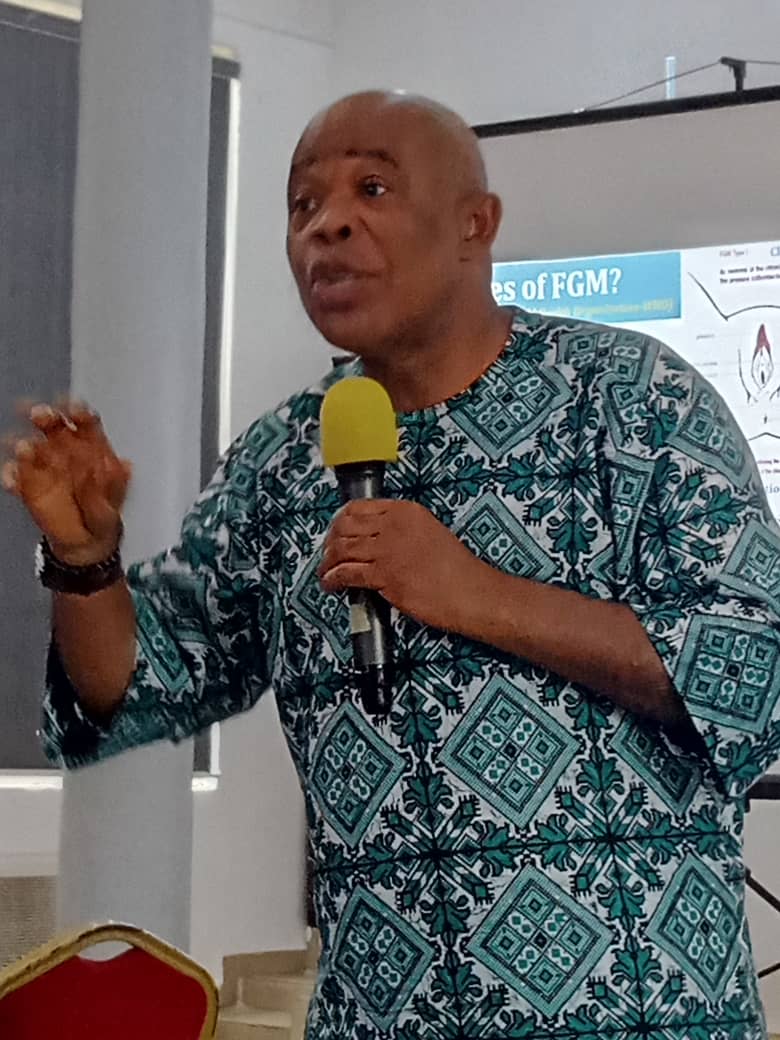
Presenting an overview and updates on FGM situation in SouthWest Nigeria, the United Nations Children’s Fund, UNICEF Child Protection Specialist, Lagos Field Office, Mr Denis Onoise said, Nigeria ranked third in the world among countries with high prevalence of Female Genital Mutilation (FGM) and Cutting.
Noting that Nigeria is third behind India and Bangladesh Onoise stated that the practice has continued to deprive girls and women of their fundamental human rights, while imposing lifelong health and economic costs.
According to the Child Protection Specialist, global reports indicate that treating FGM-related complications costs approximately $1.4 billion each year, pointed out that Nigeria, being the most populous country where FGM is practiced, faces alarming numbers.
Onoise said that FGM took many forms across communities, from cutting with sharp objects to harmful practices including repeated pressing or rubbing a new born girl’s genitalia with substances to stop its growth.
“The genitalia will not grow, but the girl will lose her full sexual and reproductive rights. It is as good as severe mutilation,” Onoise said.
The Expert stressed that FGM offers no medical benefits, instead, it leads to severe consequences, such as trauma, obstetric complications, and impaired sexual function.
“Research shows more than 50 percent of sex workers in Nigeria have undergone FGM. So the argument that cutting keeps women faithful is false,” he said.
“FGM does not stop promiscuity, it does not keep marriages, and it does not make women cleaner, as communities often claim”.
He described the practice as a social norm sustained by myths, pressure, and fear of exclusion rather than genuine tradition or religion.
“If you ask communities why they still practice FGM, they will tell you, it is what we inherited, it is what ensures marriageability” He emphasized that neither the Bible nor the Quran prescribes it. This is not religion. It is simply social pressure passed down through generations,” he said.
Onoise also said that Nigeria still faced stubborn resistance in high-prevalence states across the Southwest, Southeast, and parts of the South-South.
“Some communities have begun issuing public declarations abandoning FGM. In Anambra, for example, more than 15 communities dropped the practice last year.“But unless we accelerate change, the decline will not be fast enough to meet the 2030 target under the Sustainable Development Goals,” he said.
He charged journalists, traditional leaders, and policymakers to step up efforts in reporting, advocacy, and enforcement stressing that, courts have laws against FGM, but prosecutions are rare.
“Communities must be encouraged to speak out, and the media must spotlight stories that show both the harm of FGM and the power of change,” Onoise said.
In a goodwill message, the Chief of UNICEF Field Office for SouthWest Nigeria Celine Lafoucriere who appreciated journalists, government partners and society partners, FGM survivors and advocates in the struggle to ending the menace says, ” it is urgent and achievable”,”Female genital mutilation is never a choice, but a violation that is inflicted on women and girls”.
Lafoucriere expressed dismay that almost 20 million women and girls in Nigeria have undergone female genital mutilation and this she described as a number that cannot be ignored.
“We cannot turn a blind or deaf to,” Most of them were cut before their fifth birthday, at that age when they are completely powerless, when they can’t consent, resist or even understand what is happening to them”.she noted.
She stated that, despite being outlawed in Nigeria, the harmful practice has continues in many communities.
“It has continue to fuelled by myths, fuelled by traditions, but those myths and those traditions must be recognised as harmful myths and traditions”. ” Warning that, No culture or custom should ever come at the expense of girls’ health, rights or their future”.
She however expressed joy saying The good news is that “change is possible and change is happening.” Through collaborations which is led by the federal government of Nigeria in collaboration with UNICEF”,” Millions of Nigerian girls have already pledged to protect girls, millions of Nigerian girls, boys, men, women, aunties, uncles have pledged to protect girls from being cut. Communities are speaking out”. Lafoucriere said”
Survivors, are leading the way and young people are demanding for a better future. And this is where the media comes in.
She charged the media to use it powered to shape narratives, “to amplify survivors’ voices to challenge harmful practices and to inspire families to choose differently for their daughters”.
She expressed the confidence that the stories Journalists tell can spark the needed change, “So my call to you today is very simple. Use your reach, use your platforms and your creativity to ensure that every single girl in Nigeria grows up free of female genital mutilation, free of that fear, free of that harmful possibility”.
In her remarks, the UNICEF Communication Officer, Lagos Field Office, Blessing Ejiofor noted that the workshop is aimed at ensuring advocacy reached the nook and cranny in order to end the FGM practice in the country.
Ejiofor noted that while campaigns have led to a decline in FGM, the advocacy efforts aim for complete elimination.
The UNICEF communication specialist, who declared that “no woman should undergo the harmful process of FGM as it is now a criminal offense in Nigeria to engage in it”.
Ejiofor urged the media to use their medium to drive the advocacy even more, insisting that the time to end it is now”.
The workshop was organised by UNICEF in collaboration with the Oyo State Ministry of Information and Orientation.
Reporting by Julie Ekong