Nigeria has reaffirmed its commitment to a responsible and balanced energy transition, positioning natural gas as a key driver of industrial growth while advancing efforts to decarbonise the sector and reduce greenhouse gas emissions.
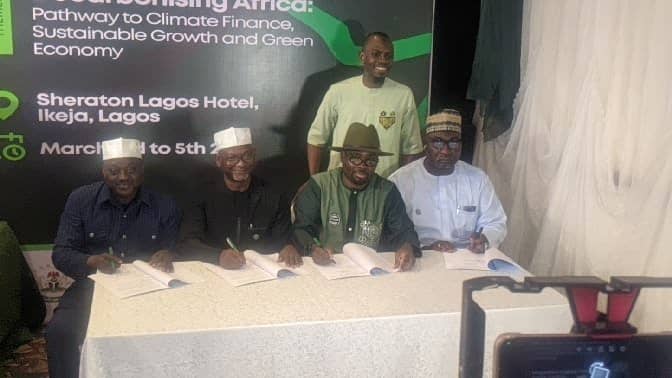
The Director-General of the National Council on Climate Change, Dr. Omotenioye Majekodunmi, made this pledge during her keynote address at the Green Conference 2026 held in Lagos.
The three-day conference, organised by GreenPlinth Africa in collaboration with the Office of the Vice President and the National Council on Climate Change, brought together stakeholders from government, the private sector and civil society to strengthen public-private collaboration toward building a sustainable green economy.
A key highlight of the conference was the signing of Memoranda of Agreement by the governments of Benue State and Niger State for the distribution of clean cookstoves to households as part of efforts to promote cleaner energy use and reduce emissions.
Other states, including Nasarawa State, are expected to join the initiative.Under the programme, each participating state will receive at least two million clean cookstoves.
Benefiting households will also receive health insurance coverage for up to eight family members, a monthly stipend of ₦10,000 and free briquettes for cooking fuel.
In her address, Majekodunmi described Africa as standing “at a pivotal moment in the history of global development,” noting that while the continent is rich in resources, innovation and human potential, millions of people still lack reliable access to modern energy.
She pointed out that Africa faces the unique challenge of pursuing industrialisation while aligning with global climate targets.
“In essence, Africa is being asked to industrialise and decarbonise at the same time,” she said, adding that the continent must achieve energy security and economic growth while advancing the global climate agenda.
Majekodunmi stressed that Nigeria’s transition strategy is built around a pragmatic energy mix, where natural gas plays a crucial role alongside renewable energy and emerging low-carbon technologies.
According to her, gas provides reliable baseline energy for industries such as steel, cement, chemicals and fertiliser production, while also serving as a stabilising partner for renewable energy systems such as solar and wind.
She explained that replacing coal and heavy fuel oil with gas could reduce greenhouse gas emissions by up to 50 per cent while improving air quality.
The director-general also noted that liquefied petroleum gas offers households a cleaner alternative to biomass and kerosene, improving both health outcomes and environmental sustainability.
However, she emphasised that Africa’s future gas development must be decarbonised and avoid replicating the high-emission systems of the past.
“This means ending routine gas flaring, deploying advanced methane detection technologies, integrating carbon capture systems and designing infrastructure capable of supporting hydrogen and other emerging energy solutions,” she said.
Majekodunmi disclosed that Nigeria had recently introduced a national framework to decarbonise the upstream, midstream and downstream segments of the oil and gas sector in collaboration with the Minister of Petroleum Resources for Gas.
She said the framework focuses on methane monitoring, emissions reduction, capacity building and climate-aligned financing, while leveraging technology to ensure measurable climate action.
According to her, Nigeria holds more than six trillion cubic feet of proven gas reserves which, if responsibly developed and decarbonised, could support industrial growth while contributing to global climate goals.
Also speaking, the Group Financial Officer and Assistant Chief Executive Officer of GreenPlinth Africa, Engineer Babatunde Aina, presented an initiative to distribute 80 million clean cookstoves across the country.
He described the programme as a transformative step in Nigeria’s journey toward building a viable green economy.
Aina noted that research shows a single traditional cooking session exposes users to smoke equivalent to inhaling 600 cigarettes, contributing significantly to respiratory diseases among women and girls across Africa.
To address the challenge, he said the organisation is partnering with federal and state governments to distribute clean cookstoves and plant four billion trees to combat deforestation and reduce greenhouse gas emissions.
According to him, the project could cut emissions by about 1.2 billion metric tonnes and position Nigeria to earn at least five billion dollars annually from the global carbon credit market.
He added that the initiative could generate at least three million direct jobs and up to sixteen million indirect jobs nationwide, with carbon projects expected to be implemented across all 774 local government areas.
Aina also revealed that hundreds of women in Makoko, Lagos, are already benefiting from the initiative through the use of emission-free cookstoves, along with incentives such as stipends, health insurance and free briquettes.
Speaking at the conference, the Chief Executive Officer of Natural Eco Capital, Dr. Eugene Itua, urged African countries to play leading roles in global climate action.
He noted that Nigeria and Africa should not only participate in the global transition to a low-carbon economy but should lead with innovation.
The conference also featured masterclasses for journalists and other participants aimed at deepening knowledge of the green economy and improving climate-focused reporting.
The event concluded with the presentation of Green Icon Awards to governments, organisations and individuals recognised for promoting carbon emission reduction.
Among the award recipients were Lagos State, Niger State and Benue State.
The Dangote Group was also honoured for its initiative to deliver petroleum products directly to customers, a strategy the company said could reduce emissions linked to transportation and distribution.
Written by Innocent Onoh